What are waterbucks? Waterbucks are large African antelopes best recognized by their strong bodies, shaggy brown-grey coats, rounded ears and the impressive curved horns carried by adult males. Their name comes from their particularly close association with water.
Unlike some African antelopes that can survive for long periods in dry landscapes far from rivers or lakes, waterbucks usually prefer habitats where dependable water is nearby. They are commonly associated with grasslands, wooded savannahs, river valleys, floodplains and other areas where they have access to both grazing and water. For travelers exploring Uganda and other parts of East Africa, seeing a waterbuck standing quietly beside a river, grazing through tall savannah grass or watching a safari vehicle from the edge of woodland can be one of the interesting wildlife encounters that adds diversity to a traditional African safari.
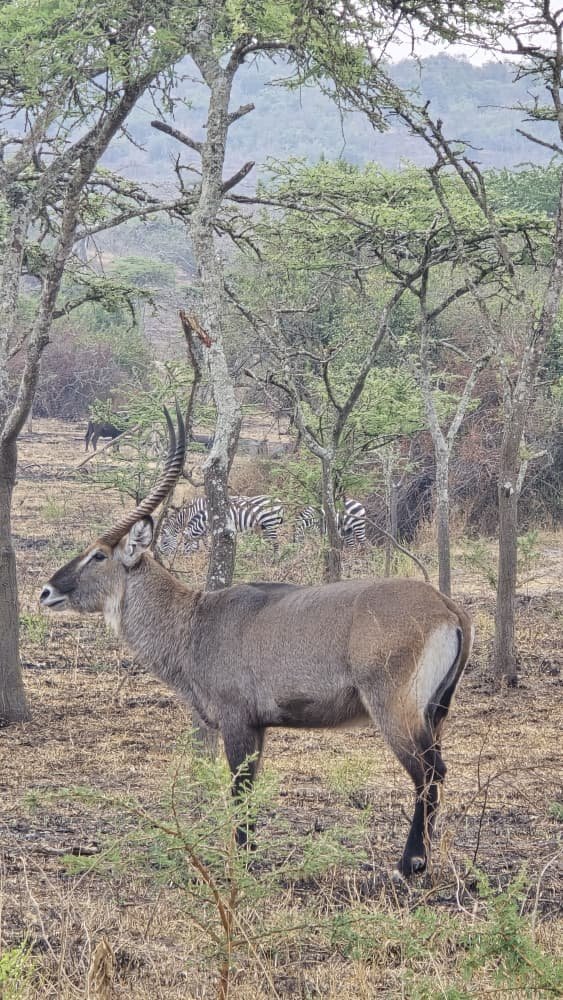
The scientific name of the waterbuck is Kobus ellipsiprymnus. Waterbucks belong to the Bovidae family, which includes antelopes, cattle, sheep and goats. They are therefore antelopes rather than deer, despite occasional similarities that inexperienced safari travelers may notice between the two groups. Waterbucks are among the larger and more robust antelopes found in Africa. Adult males are particularly impressive, developing long, strongly ridged horns that curve backward before sweeping upward. Females do not normally have horns and tend to be lighter in build than mature males.
Waterbucks occur across substantial portions of sub-Saharan Africa, although their distribution is not continuous across the entire continent. Wildlife references commonly divide waterbucks into two major geographical groups: the ellipsiprymnus group, generally associated with southeastern Africa, and the defassa group, occurring through parts of northeastern, central and western Africa. They are strongly associated with grassland near permanent water, particularly valleys and drainage areas.
For visitors traveling through Uganda, waterbucks form part of a much larger wildlife experience. Uganda Wildlife Authority manages ten national parks, including major savannah destinations such as Murchison Falls National Park, Queen Elizabeth National Park, Lake Mburo National Park and Kidepo Valley National Park. These landscapes allow visitors to experience very different combinations of mammals, birds, vegetation, rivers, lakes and dramatic scenery during one Uganda safari.
With Gabba Gorilla Expeditions, a wildlife safari can therefore extend far beyond the country’s famous mountain gorillas. A customized journey may begin with gorilla trekking in Bwindi Impenetrable National Park and continue into Uganda’s savannah ecosystems, where travelers can search for waterbucks alongside elephants, buffaloes, giraffes, zebras, Uganda kobs, bushbucks, topis, hippos, warthogs and predators such as lions and leopards. Understanding animals such as waterbucks before beginning a safari can make wildlife viewing much more rewarding because travelers begin to recognize not only individual species but also the ecological relationships between animals and their habitats.
What Is a Waterbuck?
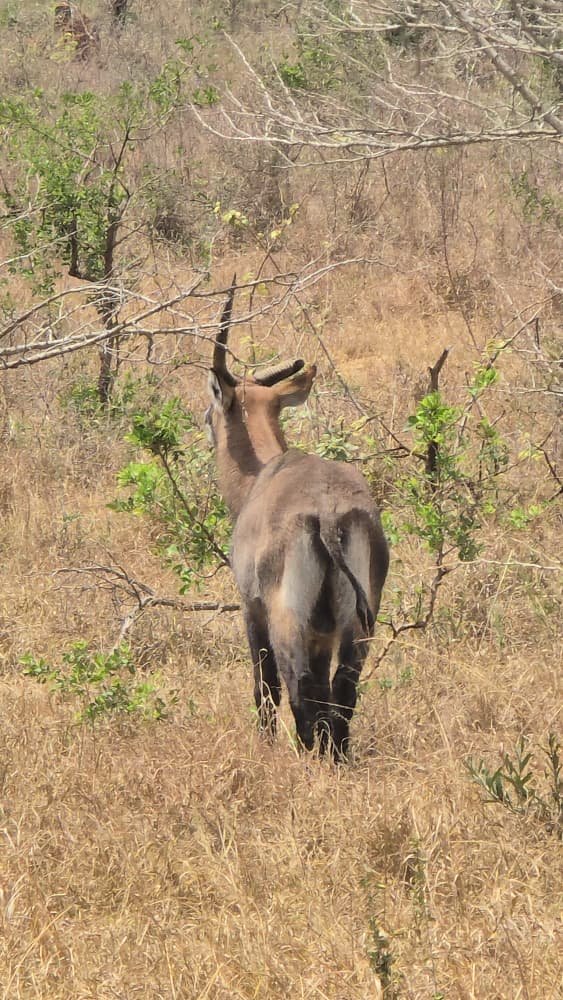
A waterbuck is a large African antelope belonging to the genus Kobus. The scientific name Kobus ellipsiprymnus refers to a species whose populations occur across different regions of sub-Saharan Africa. Its closest ecological associations are with savannah grasslands, woodland edges, valleys, river systems and other landscapes where permanent or reliable water is available. Although the animal’s English name might make newcomers imagine something resembling an aquatic antelope, the waterbuck is fundamentally a terrestrial mammal. It walks, grazes, rests and reproduces on land, but its ecology is more closely connected with water than that of many antelope species adapted to drier environments.
The waterbuck is particularly recognizable because of its substantial build. Compared with an impala, for example, a waterbuck looks considerably heavier and more muscular. It possesses a relatively long neck, broad muzzle, large ears and coarse hair that creates a somewhat shaggy appearance. The coat usually ranges through shades of grey, brown and reddish-brown, depending on individual, age, light conditions and regional population. White markings may be visible around parts of the face, throat and rump, with the rump pattern being especially useful when distinguishing different waterbuck forms.
A mature male waterbuck, often called a bull, carries long horns marked by distinctive transverse ridges. The horns sweep backward from the skull and curve upward, giving mature bulls a striking appearance. Females, often referred to as cows, are hornless. This distinction makes identifying the sex of adult waterbucks relatively straightforward during a game drive.
Waterbucks belong to the family Bovidae rather than Cervidae. This means a waterbuck is an antelope and not a deer. Deer and antelopes can sometimes appear superficially similar because both may possess long legs, herbivorous diets and adaptations for avoiding predators, but they represent different branches of hoofed mammals. One particularly obvious difference involves their head structures. Male waterbucks have permanent horns that continue to grow and are not shed annually, while deer generally possess antlers that are shed and regrown according to seasonal cycles.
For safari travelers, recognizing a waterbuck becomes easier after observing several individuals. Its heavy body, shaggy coat, large ears, male horns and conspicuous rump markings create a combination that is difficult to confuse once learned. Experienced guides use these features together with habitat and behavior to identify animals from considerable distances.
Why Are They Called Waterbucks?
Waterbucks receive their common name because of their strong ecological relationship with water. Although they do not live permanently in rivers or lakes, they are generally reluctant to move very far from dependable sources of water. Suitable waterbuck habitat often includes grassland close to rivers, wetlands, valleys, lakeshores and drainage systems where grazing resources and drinking water remain accessible.
Animal Diversity Web describes waterbucks as preferring grassland close to water, particularly habitats along drainage lines and in valleys. It also notes that although they generally favor dry ground, they remain close to water for feeding opportunities and as part of their response to predators.
This close relationship with water separates the waterbuck ecologically from certain antelope species capable of ranging across much drier landscapes. In East Africa, where seasons can significantly change vegetation, the presence of permanent rivers, lakes and wetlands can determine which animals remain in a particular area during the driest periods of the year.
However, describing waterbucks as “water animals” can be misleading. They are not comparable to hippopotamuses, which spend large portions of daylight hours immersed in water. Neither are they specialized wetland antelopes to the same degree as some species that spend extensive periods in swamp environments. A waterbuck is more accurately described as a terrestrial antelope with a strong dependence on habitats near reliable water.
This ecological preference can help safari travelers locate waterbucks. During game drives, guides often pay attention to drainage channels, riverine woodland, damp grasslands and vegetation bordering permanent water. A waterbuck encountered in such surroundings is not there by coincidence; its presence reflects the ecological conditions the species generally favors.
What Does a Waterbuck Look Like?
A waterbuck has a powerful and unmistakably robust appearance. While smaller antelopes such as impalas often appear slim, delicate and extremely athletic, an adult waterbuck has heavier shoulders, a deeper body and a more substantial neck. Large males can look particularly imposing, especially when viewed at close but safe distance from a safari vehicle.
The coat is generally coarse and shaggy rather than exceptionally short and smooth. Its coloration can vary between greyish brown, reddish brown and darker shades depending on factors including age, sex, region, season and lighting. The coarse outer hair contributes to the waterbuck’s distinctive appearance, particularly around the neck.
The head is relatively long, with large rounded ears capable of rotating toward unfamiliar sounds. Like many prey animals living alongside lions, leopards and hyenas, waterbucks rely heavily upon their senses to identify danger. Their eyes provide a wide field of view while their large ears help detect movement and sound across the surrounding landscape.
White markings provide important identification clues. Pale coloration may occur around the muzzle, throat, eyes and rump. The rump is particularly important because the two main waterbuck groups possess different white patterns.
The common or ellipsen waterbuck is famous for a white elliptical ring around the rump. From behind, this can look almost as though a white circle has been painted around the animal’s tail. The defassa waterbuck lacks the same complete ring and instead has a more extensive white rump patch. For travelers learning African wildlife identification, this difference is one of the easiest characteristics to remember.
Adult males possess horns while females are normally hornless. Male horns are long, heavily ridged and gracefully curved. As bulls mature, the horns become increasingly impressive and can help create the powerful silhouette associated with dominant adult males.
The waterbuck’s legs are strong enough to carry its considerable body rapidly when escaping danger. Despite looking bulky compared with more delicate antelope species, waterbucks should not be mistaken for slow animals. Natural selection has shaped them within ecosystems populated by highly efficient predators, making speed, alertness and rapid acceleration essential to survival.
Why Do Waterbucks Have a White Ring Around Their Rump?
One of the most frequently noticed characteristics of the common waterbuck is the dramatic white ring surrounding its rump. The marking has become so closely associated with waterbucks that some first-time safari travelers expect every individual across Africa to display exactly the same pattern.
That is not quite correct. The famous white elliptical ring is particularly characteristic of the common or ellipsen waterbuck group. Defassa waterbucks instead display a broader white rump patch rather than the complete ring associated with the common form.
The marking provides a useful visual signal among members of the species and is particularly visible when animals move away through vegetation. Similar contrasting rump or tail patterns occur in many hoofed mammals and can contribute to visual communication between individuals, especially when groups are moving.
From a safari perspective, the marking is extremely useful. Imagine several antelope species grazing hundreds of meters away. Body shape may be difficult to distinguish through tall grass, but a clear white rump pattern can immediately help an experienced guide narrow down the identification.
Visitors should therefore avoid identifying every waterbuck solely by looking for a perfect white circle. Location matters. The defassa form encountered across portions of East Africa has a different rump pattern, illustrating the importance of understanding regional wildlife variation rather than relying on one simplified illustration.
Common Waterbuck vs Defassa Waterbuck
Waterbucks are generally divided into two major geographical groups: the common or ellipsen waterbuck and the defassa waterbuck. Animal Diversity Web identifies the ellipsiprymnus group as occurring broadly through southeastern Africa and the defassa group through parts of northeastern, central and western Africa.
What Is a Common Waterbuck?
The common waterbuck is the form most strongly associated with the conspicuous white elliptical ring around the rump. This ring encircles the tail area and can remain visible even when an animal is partly hidden by grass. It is responsible for many of the popular photographs through which international travelers first become familiar with the species.
Common waterbucks are large, heavy-bodied antelopes whose males develop powerful curved horns. Their general ecology remains strongly linked to grassland and woodland habitats close to permanent water.
What Is a Defassa Waterbuck?
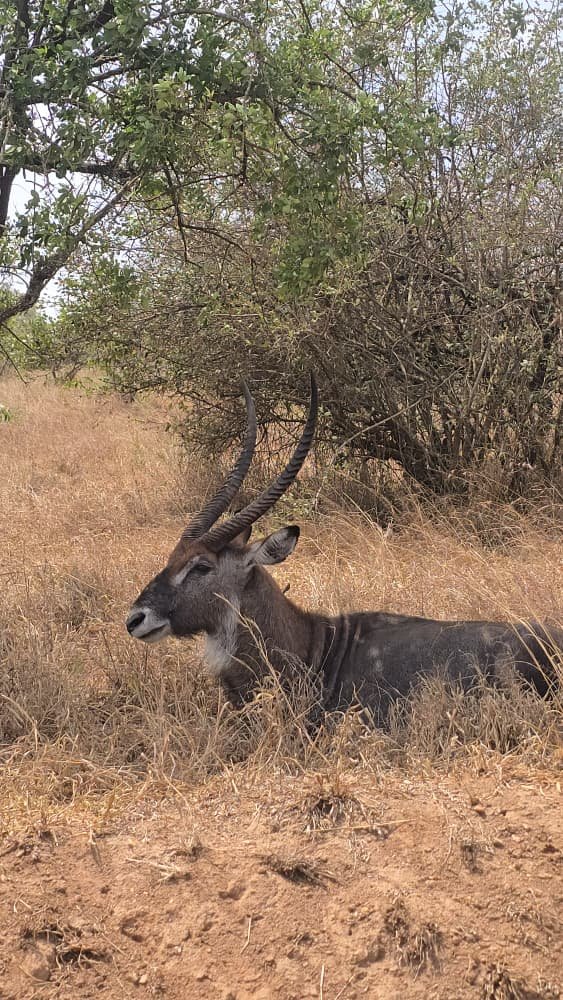
The defassa waterbuck shares the overall heavy body, shaggy coat and water-dependent ecology characteristic of waterbucks but differs noticeably in its rump markings. Rather than displaying the complete white ellipse associated with the common waterbuck, defassa animals generally show a broader white patch around the rump.
For travelers on safari in parts of East Africa, learning this distinction is particularly useful. A visitor who has previously seen photographs of southern African waterbucks may initially wonder why animals encountered farther north do not display the famous white ring. The answer often relates to geographical variation within the species.
Both forms still belong to the same broader waterbuck species complex, and their similarities far outweigh their superficial differences. The distinction nevertheless demonstrates how wildlife populations adapt and vary across the enormous landscapes of Africa.
How Big Is a Waterbuck?
Waterbucks rank among the larger African antelopes. A mature male has a deep chest, substantial shoulders and a thick neck that can make him appear much heavier than a female standing nearby. Mature bulls commonly reach weights well above 200 kilograms, though measurements vary between populations and individuals. Females are generally smaller and lighter.
Their substantial size becomes most obvious when travelers see waterbucks near smaller antelopes. An impala or Uganda kob may appear relatively slender beside a fully mature bull waterbuck.
Body size provides several ecological advantages. Larger adults can be less vulnerable to certain predators than small antelopes, and mature males can use both body mass and horns during competition with rivals. However, large size also creates nutritional demands. Waterbucks require sufficient vegetation and reliable water, helping explain their strong association with productive habitats near wetlands, rivers and drainage systems.
The sexual difference in body size is complemented by the presence of horns only in males. Together, the muscular neck, large body and curved horns make an adult bull relatively easy to distinguish during wildlife viewing.
Do Female Waterbucks Have Horns?
Female waterbucks are normally hornless. Horns are a male characteristic, and they become increasingly impressive as bulls mature.
This difference between the sexes is known as sexual dimorphism. Male waterbucks use their horns particularly during displays and competition with other males. Two bulls may assess one another before engaging physically, and when fighting occurs their horns provide powerful structures for pushing and contesting dominance.
Females tend to have slimmer necks and lighter overall bodies. When groups include mature males, females and younger animals, the adult bull can therefore stand out immediately.
Horns should never be confused with antlers. Waterbuck horns are permanent structures rather than seasonally shed antlers. They grow from the skull and remain with the animal throughout adult life.
Where Do Waterbucks Live?
Waterbucks generally inhabit sub-Saharan African landscapes where open grazing and dependable water occur relatively close together. Their preferred environments can include savannah grasslands, wooded grasslands, river valleys, floodplains, wetland margins and drainage systems.
The crucial ecological factor is the availability of reliable water. Waterbucks usually avoid extremely arid areas where access to drinking water becomes unpredictable. Animal Diversity Web notes that their best habitats occur near drainage lines and valleys and emphasizes the species’ tendency to remain close to water.
Waterbuck habitat should therefore be understood as a mosaic rather than one vegetation type. An individual may graze in relatively open grassland in the morning, retreat toward thicker vegetation during hotter hours and remain within reach of a river, swamp, lake or other water source.
These habitat preferences can change with seasonal rainfall. During wetter periods, grasses and temporary water may be widely distributed, allowing animals greater flexibility. During prolonged dry conditions, permanent water sources become increasingly important and can influence wildlife concentrations.
This is one reason dry-season game viewing in some African parks can be particularly productive around permanent rivers and lakes. Different herbivores may congregate within accessible distance of the remaining water, and predators can respond to these concentrations.
Where Are Waterbucks Found in Africa?
Waterbucks occur across broad parts of sub-Saharan Africa, although their distribution is fragmented rather than covering every country and habitat continuously. They are particularly associated with regions capable of providing suitable grassland or woodland alongside dependable water.
The two main waterbuck groups broadly occupy different geographical areas. The ellipsiprymnus group is mainly associated with southeastern Africa, while the defassa group occurs farther through parts of northeastern, central and western Africa.
East Africa forms an important part of the waterbuck’s continental distribution. Uganda, Kenya and Tanzania contain extensive protected landscapes offering combinations of grassland, woodland, wetlands and permanent waterways suitable for many savannah herbivores.
However, travelers should remember that being within a country’s general waterbuck range does not guarantee seeing the animal everywhere. Wildlife distribution depends upon habitat, water, predator pressure, human activity, protected-area management and local population conditions.
Where Can You See Waterbucks in Uganda?
Uganda provides excellent opportunities for travelers interested in seeing a wide variety of African antelopes during the same journey. The country combines equatorial forests, Rift Valley landscapes, wetlands, lakes, rivers and savannah parks, creating habitats for remarkably different wildlife communities.
Uganda Wildlife Authority manages national parks including Queen Elizabeth, Murchison Falls, Lake Mburo and Kidepo Valley, alongside forest destinations such as Bwindi and Kibale.
For clients of Gabba Gorilla Expeditions, this makes it possible to combine a waterbuck and general wildlife safari with gorilla trekking, chimpanzee tracking and other experiences rather than treating savannah viewing and primate trekking as completely separate journeys.
Waterbucks in Murchison Falls National Park
Murchison Falls National Park represents one of Uganda’s classic big-game safari landscapes. Open savannah, woodland, the Nile and associated riverine habitats create opportunities to observe a wide range of mammals during game drives and boat-based experiences.
Waterbuck sightings can form part of the wider game-viewing experience, alongside species such as elephants, buffaloes, giraffes, Uganda kobs, hippos and various predators. The landscape’s relationship with the Nile makes Murchison particularly interesting when considering animals whose ecology is closely associated with water.
The park also allows travelers to combine wildlife viewing with one of Uganda’s most dramatic natural landmarks: Murchison Falls, where the Nile is forced through a narrow rocky channel before continuing downstream.
Waterbucks in Queen Elizabeth National Park
Queen Elizabeth National Park is another important destination for travelers hoping to experience Uganda’s savannah wildlife. Its combination of open plains, crater landscapes, wetlands, channels, lakes and woodland creates a highly varied safari environment.
Game drives may reveal numerous herbivores, while boat experiences on the Kazinga Channel introduce visitors to an especially rich aquatic and waterside ecosystem.
Waterbucks fit naturally into such a landscape because of their preference for grasslands near dependable water. Rather than searching for them in isolation, visitors can appreciate them as one component of a much broader ecological community.
Waterbucks in Lake Mburo National Park
Lake Mburo National Park is particularly interesting for antelope enthusiasts because of the variety of hoofed mammals occurring within a comparatively compact protected landscape.
Historical Uganda Wildlife Authority monitoring records specifically include waterbuck among the medium and large mammals recorded in the Lake Mburo ecosystem. UWA’s conservation data documented waterbucks alongside animals such as impalas, zebras, elands, buffaloes and topis.
Lake Mburo also provides a different safari atmosphere from Uganda’s larger savannah parks. Uganda Wildlife Authority highlights experiences in the park that include walking safaris, allowing visitors to appreciate landscapes and wildlife from perspectives different from conventional vehicle-only game viewing.
For guests traveling between Entebbe or Kampala and southwestern Uganda, Lake Mburo can also fit naturally into itineraries continuing toward Bwindi Impenetrable National Park or Mgahinga Gorilla National Park.
Waterbucks in Other Ugandan Wildlife Areas
Waterbuck distribution extends beyond one or two famous national parks. Their presence depends upon suitable habitat, particularly the combination of grazing and dependable water.
Wildlife sightings should never be presented as guaranteed. These are free-ranging wild animals whose movements respond to rainfall, vegetation, human disturbance, reproduction, predator activity and numerous ecological conditions.
Gabba Gorilla Expeditions therefore designs wildlife itineraries around habitat and opportunity rather than artificial promises. An experienced guide reads the landscape, checks recent sightings where appropriate, studies animal behavior and explores suitable areas while recognizing that uncertainty is part of authentic wildlife viewing.
What Do Waterbucks Eat?
Waterbucks are herbivores and predominantly grazers. Their diet consists mainly of grasses, although the exact vegetation selected can change according to season, habitat quality, rainfall and local plant availability.
Fresh grass is particularly valuable because it provides both nutrition and moisture. During rainy periods, new growth can spread widely through the landscape. In dry periods, greener vegetation may remain concentrated closer to permanent water or areas retaining greater soil moisture.
A waterbuck’s feeding behavior is therefore closely linked to its habitat preference. The animal does not simply remain near water because it enjoys standing beside rivers. Water influences the vegetation communities available for grazing and therefore affects the quality and reliability of food.
Like other ruminant herbivores, waterbucks possess specialized digestive systems that allow them to process fibrous plant material. Food is swallowed and later regurgitated as cud for additional chewing, enabling the animal to extract nutrients efficiently from grasses that humans and many other mammals cannot digest.
Waterbuck grazing also contributes to ecosystem processes. Herbivores influence vegetation height, nutrient cycling and plant composition while simultaneously forming prey for large carnivores. A waterbuck is therefore connected to multiple layers of the food web.
Are Waterbucks Herbivores?
Yes. Waterbucks are herbivorous mammals and feed primarily on plant material, with grasses forming an important part of their diet.
They do not hunt smaller animals and should not be confused with omnivores. Their teeth, digestive system and feeding behavior are specialized for processing vegetation.
During safari drives, visitors may observe waterbucks grazing slowly through grasslands, periodically raising their heads to watch for danger. This alternating pattern of feeding and vigilance is typical of prey animals living in landscapes where predators can appear unexpectedly.
Do Waterbucks Drink a Lot of Water?
Waterbucks have a much stronger dependence on regular access to water than many antelopes adapted to arid regions. This is one of the principal reasons they remain strongly associated with rivers, lakes, wetlands and drainage systems.
Reliable water affects both direct drinking requirements and the vegetation available to the animals. Productive grasses often remain greener around areas with greater moisture, allowing waterbucks to meet nutritional needs more consistently.
During dry conditions, this relationship becomes even more obvious. As temporary pools disappear and surrounding grass dries, permanent rivers and wetlands become ecological refuges for numerous animals.
The relationship between waterbucks and water demonstrates an important principle for anyone trying to understand safari wildlife: animals are rarely distributed randomly. Their location reflects food, water, cover, temperature, competition, predators and reproductive needs.
Waterbuck Behavior and Social Life
Waterbucks display flexible social behavior rather than living permanently in one fixed type of herd. Females may occur in relatively loose groups, often with young animals, while younger males can form bachelor associations. Mature males may establish territories in productive habitat and attempt to maintain access to females moving through those areas.
The size and composition of groups vary according to ecological conditions. Food availability, water distribution, breeding activity, habitat structure and population density can all influence how many animals occur together.
Territorial bulls use visual displays, posture, scent and physical confrontation to communicate with rivals. Although actual fights can happen, avoiding unnecessary serious injury is advantageous. Animals can often assess competitors before escalating conflict.
Waterbucks also spend substantial time watching their surroundings. When one individual detects a possible threat, its behavior can alert others nearby. A suddenly raised head, fixed gaze or rapid movement can trigger a response across the group.
Safari guides frequently use herbivore behavior to detect predators. A group of antelopes staring intensely in the same direction can indicate that something unusual has captured their attention. This does not always mean a lion or leopard is present, but experienced guides learn to interpret subtle changes in animal behavior.
Are Waterbucks Territorial?
Adult male waterbucks can be territorial, particularly in good-quality habitat where females are likely to pass through.
A territorial bull attempts to maintain access to a defined area and may challenge rival males entering it. The quality of a territory can depend on grazing, cover and access to water.
Territorial behavior contributes to competition between males. A stronger or more established bull may gain more opportunities to reproduce, providing an evolutionary incentive for the development of substantial body size and horns.
Not every male holds territory. Younger males and animals unable to secure productive areas may associate in bachelor groups until they reach the age and physical condition required to compete more effectively.
Why Do Male Waterbucks Fight?
Male waterbucks fight primarily because of competition over territory, status and reproductive opportunities.
Their impressive horns are important during these encounters. Bulls can lower their heads, engage horns and push against each other, testing strength and dominance.
Such contests are not meaningless aggression. Reproductive competition is an important evolutionary force shaping body size, horn development and behavior in many antelope species.
Travelers fortunate enough to observe male interaction should remain quiet and allow the animals to behave naturally. Wildlife should never be provoked simply to create photographs or dramatic safari moments.
Waterbuck Reproduction and Life Cycle
Waterbuck reproduction follows the broader pattern typical of large antelopes, with males competing for access to receptive females and females carrying the primary responsibility for gestation and early care of offspring.
After mating, a female undergoes a gestation period before giving birth to a single calf in most cases. Newborn calves are extremely vulnerable to predators and initially depend heavily on concealment and maternal protection.
Rather than keeping very young calves continuously exposed within open groups, mothers may leave them hidden in vegetation while moving away to feed. The mother returns regularly to nurse and care for the calf. Remaining motionless and concealed reduces the chance of attracting predators.
As calves become stronger, they increasingly accompany their mothers and other waterbucks. Young animals gradually learn the feeding areas, safe resting habitats, water locations and social behaviors necessary for survival.
Juvenile males eventually begin developing horns and become increasingly distinct from females. As they mature, they may join bachelor groups before attempting to establish themselves within adult male social systems.
Reproduction connects waterbucks to predator populations as well. Young calves represent potential prey for a wider range of carnivores than healthy adult bulls, meaning reproductive success depends not simply upon giving birth but upon protecting offspring through their most vulnerable stages.
What Is a Baby Waterbuck Called?
A baby waterbuck is called a calf.
Waterbuck calves are born comparatively well developed but remain highly vulnerable during their earliest weeks. Their survival strategy includes concealment within vegetation, staying quiet and relying on the mother’s visits for nursing.
As the calf becomes larger and faster, it begins accompanying its mother more regularly and eventually integrates more fully into the social environment.
For photographers, young waterbucks can be attractive subjects, but safari travelers should always maintain appropriate distance. A young animal apparently lying alone should never be assumed to have been abandoned. The mother may simply be feeding nearby while deliberately keeping the calf concealed.
What Animals Eat Waterbucks?
Waterbucks live alongside some of Africa’s most capable carnivores. Lions are among the predators capable of killing adult waterbucks, while leopards, spotted hyenas and African wild dogs may prey upon waterbucks where their distributions overlap and circumstances provide opportunities.
Young calves are considerably more vulnerable because of their smaller body size. A wider range of predators can threaten juveniles.
Crocodiles can also represent danger when terrestrial mammals enter or approach suitable waterways, although this should not be exaggerated into the idea that crocodile predation controls every aspect of waterbuck behavior.
Waterbucks survive predator-rich landscapes through a combination of awareness, speed, group vigilance, habitat use and physical strength. Mature males additionally possess formidable horns, although escaping danger is generally preferable to direct confrontation with a large carnivore.
Predation is an essential ecological process. It can be emotionally difficult for travelers to witness, particularly when a calf or other vulnerable animal is involved, but predators and prey have evolved together. Removing natural predation from an ecosystem can produce major ecological consequences.
How Do Waterbucks Protect Themselves?
The waterbuck’s first defenses are usually detection and avoidance. Large ears, wide vision and constant awareness help individuals identify danger before a predator gets within striking distance.
When threatened, waterbucks can run powerfully despite their heavy bodies. Staying close to familiar habitat and reliable water may provide additional escape options depending on the type of predator and surrounding landscape.
Group living can also increase vigilance. Several animals feeding together create more eyes and ears capable of detecting an approaching threat.
Adult males have horns capable of causing serious injury, but this does not mean bulls deliberately seek combat with predators. Running away remains a safer strategy whenever escape is possible.
Habitat itself provides another layer of protection. Woodland edges and tall vegetation can provide concealment, while open terrain allows animals to see approaching danger from greater distances. Waterbucks must continually balance these different advantages.
Do Waterbucks Hide in Water From Predators?
Waterbucks are capable of entering water and may use water-associated environments while escaping danger, which has contributed to the widespread statement that waterbucks “hide in water” whenever predators approach.
The reality is more complicated. Waterbucks do not automatically jump into a river every time they detect a lion. Their response depends on the predator, distance, terrain, vegetation and available escape routes.
Water can sometimes provide an obstacle that certain terrestrial predators are reluctant to cross, but entering water creates different risks, including crocodiles in suitable habitats.
A more accurate statement is that proximity to water forms part of the ecological environment waterbucks use for survival. It should not be reduced to a single universal escape behavior.
Do Waterbucks Smell?
Waterbucks have skin secretions that can give their coats a characteristic odor, particularly noticeable in mature individuals.
This has generated many safari stories and exaggerated myths. One common story claims that predators refuse to eat waterbucks because they smell unpleasant. That is clearly an oversimplification because lions and other carnivores do prey upon waterbucks.
The oily secretions associated with the skin and coat may contribute to maintaining the animal’s hair and provide some resistance to moisture, which makes ecological sense for a species that regularly occupies damp environments and remains close to water.
For safari interpretation, the waterbuck’s characteristic coat offers an interesting example of how seemingly simple physical traits can be linked to an animal’s habitat and lifestyle.
Is a Waterbuck Waterproof?
Calling a waterbuck completely “waterproof” would be inaccurate, but its coarse hair and oily skin secretions can help repel moisture.
The animal therefore has adaptations suited to living in habitats where contact with wet grass, riverside vegetation and damp environments is frequent.
This does not transform a waterbuck into an aquatic mammal. Its body is still fundamentally designed for terrestrial movement, grazing and running.
When learning wildlife facts, travelers should be cautious about absolute statements. Phrases such as “waterproof antelope” may work well in casual safari storytelling but often simplify much more interesting biological adaptations.
Waterbuck vs Bushbuck – What Is the Difference?
Waterbucks and bushbucks are both African antelopes, but they differ considerably in size, appearance, behavior and preferred habitat.
A waterbuck is substantially larger and heavier. Mature males possess long, curved, ridged horns, while male bushbucks have much shorter horns. Waterbucks generally have shaggy grey-brown coats and noticeable white rump markings depending on geographical form.
Bushbucks tend to favor thicker vegetation and are often more secretive. Their coloration varies geographically but can include striking spots, stripes and other pale markings.
Waterbucks are more strongly associated with dependable water and open or semi-open grassland and woodland mosaics. Although bushbucks may also occur around rivers and forests, their ecology is not defined by the same close relationship with permanent water.
On safari, behavior is often as useful as appearance. A large antelope standing in relatively open grassland near a river may fit a waterbuck profile, while a smaller solitary antelope quickly disappearing into dense vegetation is more characteristic of bushbuck behavior.
Waterbuck vs Uganda Kob – What Is the Difference?
Travelers visiting Uganda frequently encounter both waterbucks and Uganda kobs, making this one of the most useful identification comparisons.
A waterbuck is generally larger, heavier and shaggier than an Uganda kob. Mature male waterbucks carry long ridged horns sweeping backward and upward, whereas male Uganda kobs possess differently shaped horns and a more compact body.
Uganda kobs often occur on open grasslands and can sometimes gather in substantial numbers. Their coat is generally smoother and more reddish-brown or golden compared with the coarse grey-brown appearance common in waterbucks.
The Uganda kob also holds special national significance and is one of Uganda’s distinctive antelopes. Visitors exploring parks such as Queen Elizabeth and Murchison Falls may have opportunities to compare the two species in the same safari.
Learning these differences transforms a game drive. Instead of seeing “many antelopes,” travelers begin recognizing individual species, ecological niches and behaviors.
Waterbuck vs Impala
The size difference between waterbuck and impala is usually immediately noticeable. Waterbucks are considerably larger and more heavily built, while impalas are slender, elegant antelopes known for exceptional agility.
Male impalas carry lyre-shaped horns that differ substantially from the longer, heavier ridged horns of male waterbucks.
Impala coats are smoother and usually more strongly reddish or tan across the back, with contrasting pale underparts and characteristic markings around the rump and tail. Waterbucks appear shaggier, heavier and generally greyer.
Habitat can overlap, but impalas are not tied to permanent water to the same degree as waterbucks.
In Uganda, Lake Mburo National Park is especially useful for travelers wishing to improve antelope identification because several grazing species occur within the ecosystem. Historical UWA monitoring includes both impala and waterbuck among the mammals recorded there.
Waterbuck vs Kudu
A mature kudu and mature waterbuck are both large African antelopes, but their appearance is dramatically different.
The most obvious distinction is the horns. Greater kudu bulls possess spectacular spiral horns, whereas waterbuck horns sweep backward and upward without forming the same corkscrew structure.
Kudus also typically have vertical white stripes across their flanks, a physical characteristic absent from waterbucks. Their bodies appear taller and somewhat slimmer, while a mature waterbuck often looks more compact and muscular.
Waterbucks additionally display their characteristic rump markings and shaggy coat.
These comparisons show why observing shape, markings, horns and habitat together is more reliable than identifying an animal from size alone.
Are Waterbucks Dangerous to Humans?
Waterbucks are generally not aggressive animals seeking confrontation with people. Their normal response to perceived danger is to remain alert, move away or run.
However, every waterbuck is a wild animal. A large adult male possesses powerful muscles and formidable horns capable of causing serious injury if cornered, threatened or handled.
Tourists should never approach free-ranging waterbucks simply because they appear calm. Animals observed from safari vehicles are sometimes accustomed to vehicles as neutral objects but may react very differently to a person leaving a vehicle and walking toward them.
Visitors participating in authorized walking safaris should follow their guides’ instructions carefully. Uganda Wildlife Authority highlights walking safaris among experiences offered in destinations such as Lake Mburo, but these activities take place within structured wildlife-tourism environments.
Responsible wildlife tourism depends upon allowing animals sufficient space to continue feeding, resting and interacting naturally.
Can Waterbucks Swim?
Yes, waterbucks are capable of swimming.
Their close association with rivers, floodplains and other water-rich habitats means the ability to enter and cross water can be useful. However, waterbucks should not be described as specialized aquatic swimmers comparable to hippopotamuses.
Swimming is one ability within a much broader terrestrial lifestyle.
Like many large African mammals, a waterbuck crossing water must also remain conscious of danger. Rivers and lakes can contain crocodiles, meaning entering water is not automatically safer than remaining on land.
How Fast Can a Waterbuck Run?
Waterbucks are capable runners despite their substantial body size.
Exact claims about top speed vary considerably between wildlife sources and are often repeated without reliable measurements. From a biological perspective, the more important point is that waterbucks have evolved sufficient acceleration and endurance to survive alongside fast predators.
A waterbuck attempting to escape does not depend only upon maximum speed. Early detection, distance from the predator, terrain, cover, group behavior and choice of escape direction can determine survival.
This is another reason experienced safari guides watch prey behavior closely. A stationary antelope staring toward thick grass may already have detected something invisible to vehicle occupants.
How Long Do Waterbucks Live?
Waterbuck lifespan varies depending upon whether animals live in natural environments or managed captivity and according to individual circumstances.
In the wild, survival is influenced by predators, injury, disease, drought, nutritional availability, reproductive demands and competition.
Animals surviving their vulnerable early years may live for many years, but there is no single lifespan that applies to every individual.
Wildlife biology is most accurately understood through ranges and probabilities rather than assuming all members of a species live to one exact age.
Are Waterbucks Endangered?
Waterbuck conservation should be viewed within the wider health of African savannah, woodland, wetland and riverine ecosystems.
Even species that remain relatively widespread can experience local declines when habitat is lost, wetlands are degraded, wildlife corridors disappear or illegal hunting increases.
Uganda offers an important example of why protected areas matter. Uganda Wildlife Authority manages national parks and wildlife reserves as part of its mandate to conserve wildlife and ecosystems.
Protected landscapes do much more than conserve famous animals such as gorillas, elephants and lions. They also protect waterbucks and hundreds of other mammals, birds, reptiles, amphibians, insects and plant species that receive considerably less international attention.
Human-wildlife conflict remains another important conservation issue. In August 2026, Uganda Wildlife Authority described pressures around conservation areas where shrinking wildlife habitat can bring animals and neighboring communities into greater competition over resources including water and grazing land.
Sustainable tourism can therefore contribute to conservation by attaching economic value to functioning ecosystems, supporting protected-area management and creating incentives for landscapes to remain valuable as wildlife habitat.
Why Are Waterbucks Important to African Ecosystems?
Waterbucks may not receive the international attention given to lions, elephants, gorillas or rhinoceroses, but they remain important members of African ecosystems.
As herbivores, waterbucks consume grasses and participate in the transfer of energy from plants into higher levels of the food web. Predators that hunt waterbucks depend indirectly upon the vegetation supporting those herbivores.
Grazing can influence vegetation structure, while dung returns nutrients to the soil and supports insects and microorganisms. Those organisms themselves become resources for birds and other animals.
Waterbucks can also indicate the ecological importance of reliable water sources. A healthy population depends upon sufficient vegetation, access to water and enough habitat to move between feeding and resting areas.
This interconnectedness is one of the greatest lessons a safari can provide. The African wilderness is not simply a collection of spectacular animals placed beside one another. It is a network of relationships involving rainfall, soil, plants, herbivores, predators, scavengers, insects and human communities.
Best Time to See Waterbucks in Uganda
Waterbucks can potentially be observed throughout the year in Uganda’s suitable savannah habitats, but seasonal conditions affect the character of wildlife viewing.
During drier periods, vegetation in some areas becomes shorter and animals may concentrate more noticeably around dependable water. Reduced grass height can improve visibility, although conditions vary by park and year.
Rainy periods transform the landscape into lush green environments that can be excellent for photography. New grass provides abundant grazing, while dramatic skies and vegetation create beautiful photographic settings. Wildlife may become more widely dispersed because water is available across a larger area.
There is therefore no single month during which waterbucks suddenly become available and another when they disappear completely.
When Gabba Gorilla Expeditions plans an Uganda wildlife itinerary, the best timing should consider the entire safari rather than one species alone. A traveler combining waterbuck viewing with gorilla trekking, chimpanzee tracking, birding, photography and general game viewing may have priorities different from somebody visiting only for a short savannah safari.
How to Photograph Waterbucks on Safari
Waterbucks are excellent wildlife photography subjects because their large bodies, expressive ears, male horns and contrasting rump markings provide multiple photographic possibilities.
Early morning and late afternoon often provide attractive natural light. Lower-angle sunlight can bring texture into a male’s horns and highlight the coarse hair around the neck.
Instead of photographing only static side profiles, watch for behavior. A bull interacting with another male, a female attending a calf, an animal drinking, several waterbucks watching a distant predator or an individual emerging through morning grass can tell a stronger visual story.
Background matters as much as the subject. A waterbuck photographed against a river, woodland edge or open savannah provides ecological context.
Travelers should never pressure guides to drive too close simply because they want a photograph filling the entire frame. Longer lenses and patient observation usually create better results while minimizing disturbance.
Wildlife photography works best when animals are allowed to behave naturally.
Waterbucks and Other Wildlife You Can See in Uganda
One reason Uganda is particularly rewarding for wildlife travelers is the possibility of combining forest primates and savannah mammals within a single itinerary.
A Uganda safari may introduce travelers to waterbucks, Uganda kobs, bushbucks, topis, impalas, elands, zebras, giraffes, buffaloes, elephants, hippos, warthogs and numerous smaller mammals. Predators may include lions, leopards and spotted hyenas depending upon destination and luck.
The same journey can continue into forests supporting chimpanzees and eventually to the southwestern mountains where visitors trek mountain gorillas.
This combination gives Uganda a safari identity quite different from destinations focusing mainly upon open savannah game viewing.
Uganda Wildlife Authority currently manages ten national parks covering environments ranging from Bwindi’s famous forest to Murchison Falls, Queen Elizabeth, Lake Mburo, Kidepo Valley, Kibale, Semuliki and mountain ecosystems.
For Gabba Gorilla Expeditions, the objective is to connect these environments into one coherent journey rather than treating each destination as an isolated attraction.
Combining Waterbuck Viewing With Gorilla Trekking
Travelers do not normally travel thousands of kilometers to Uganda exclusively to find a waterbuck. The real value comes from incorporating waterbuck sightings into a richer journey through Uganda’s landscapes and wildlife.
A particularly effective itinerary can combine Bwindi Impenetrable National Park with Queen Elizabeth National Park.
The forest environment of Bwindi introduces travelers to mountain gorillas and a completely different ecosystem from the savannah. Traveling between the two landscapes demonstrates how quickly Uganda’s habitats can change.
Another possibility combines Lake Mburo National Park with Bwindi. Lake Mburo can provide opportunities for savannah wildlife viewing before or after the gorilla trekking experience.
Longer itineraries may continue northward toward Murchison Falls National Park, creating a comprehensive journey incorporating the Nile, game drives, river environments and additional large-mammal viewing.
Travelers with more time can also include chimpanzee tracking in Kibale National Park, making the journey a combination of savannah wildlife, mountain gorillas and chimpanzees.
This is where a specialized tour operator can add substantial value. Gorilla permits, accommodation, road transfers, domestic flights where appropriate, park activities and the geographic sequence of destinations need to fit together efficiently.
See Waterbucks on Safari With Gabba Gorilla Expeditions
Gabba Gorilla Expeditions organizes private and customized wildlife journeys across Uganda and the wider East African region, combining iconic wildlife experiences with comfortable logistics and carefully planned itineraries.
Although gorilla trekking remains central to many of our journeys, Uganda offers far more than gorillas alone. We believe a well-designed Uganda safari should allow travelers to understand the variety of landscapes and wildlife that make the country exceptional.
Our guests can begin with wildlife viewing in savannah destinations such as Murchison Falls National Park, Queen Elizabeth National Park or Lake Mburo National Park before continuing into the forests and mountains of southwestern Uganda.
Along the way, travelers may encounter waterbucks alongside Uganda kobs, bushbucks, impalas, zebras, giraffes, elephants, buffaloes, hippos and other wildlife depending on the parks included.
Our driver-guides do more than identify animals. Good interpretation explains why a species lives in a particular habitat, what it eats, how males and females differ, what predators it faces and how seasonal conditions influence its behavior.
That means seeing a waterbuck becomes more than simply checking another species from a list. The animal becomes part of a larger story about Uganda’s rivers, savannahs, predators, vegetation and conservation.
Gabba Gorilla Expeditions can tailor itineraries around the traveler’s available time, preferred accommodation standard, wildlife interests, trekking plans and desired pace. For guests seeking premium journeys, carefully chosen luxury lodges, private transportation and thoughtfully paced itineraries allow wildlife viewing to remain comfortable without losing the sense of adventure that defines an African safari.
Interesting Facts About Waterbucks
Waterbucks Are Antelopes, Not Deer
Despite their hoofed appearance and the presence of horns in males, waterbucks are African antelopes belonging to the Bovidae family. They should therefore not be described as African deer.
Only Male Waterbucks Have Horns
Adult male waterbucks develop long, ridged horns. Females are normally hornless, making sex identification comparatively straightforward among mature animals.
Waterbucks Prefer Habitats Close to Water
Their name accurately reflects their ecology. Waterbucks generally remain close to dependable water and favor productive grasslands, valleys and similar habitats.
Not Every Waterbuck Has the Famous White Ring
The elliptical white rump ring is especially characteristic of the common waterbuck. Defassa waterbucks have a broader white rump patch.
Waterbucks Are Larger Than Many Visitors Expect
Photographs sometimes fail to communicate their scale. A mature bull is a large, muscular antelope capable of looking extremely impressive when encountered at relatively close range.
Waterbucks Are Primarily Grazers
Grass forms the principal component of their diet, linking them closely to productive savannah and grassland habitats.
Waterbucks Have a Shaggy Coat
Their coarse hair gives waterbucks a distinctive appearance that separates them visually from smoother-coated antelopes such as impalas.
Waterbucks Can Swim
They are capable swimmers and can enter water, although they remain fundamentally terrestrial animals rather than aquatic mammals.
Waterbucks Have an Oily Skin Secretion
Their characteristic coat contains secretions that contribute to its texture and moisture resistance. This characteristic has also generated numerous safari myths about waterbuck odor.
Waterbucks Have Several Natural Predators
Lions, leopards, hyenas and other large carnivores can hunt waterbucks depending upon the ecosystem and circumstances.
Frequently Asked Questions About Waterbucks
What Are Waterbucks?
Waterbucks are large African antelopes belonging to the species Kobus ellipsiprymnus. They have heavy bodies, shaggy coats and a strong ecological association with reliable water. Adult males carry long curved horns while females are normally hornless.
Is It Waterbuck or Waterback?
The correct English spelling is waterbuck. The plural form is waterbucks. “Waterback” is a common spelling mistake.
Why Are Waterbucks Called Waterbucks?
They receive the name because they generally remain close to reliable water sources and prefer grasslands, valleys and woodland habitats where permanent water is accessible.
Are Waterbucks Antelopes?
Yes. Waterbucks are antelopes belonging to the Bovidae family.
Is a Waterbuck a Deer?
No. Waterbucks are antelopes rather than deer. Deer belong to a different biological family and generally possess antlers rather than the permanent horns found in waterbucks.
What Do Waterbucks Eat?
Waterbucks are herbivores and predominantly grazers. Grasses provide much of their diet, with feeding patterns changing according to habitat and season.
Where Do Waterbucks Live?
They live in parts of sub-Saharan Africa and generally favor grasslands, woodland edges, valleys, floodplains and other habitats close to reliable water.
Are Waterbucks Found in Uganda?
Yes. Waterbucks occur in suitable wildlife habitats in Uganda, including protected savannah ecosystems. Historical Uganda Wildlife Authority monitoring, for example, documents waterbucks in Lake Mburo National Park.
Where Can I See Waterbucks in Uganda?
Travelers may encounter waterbucks in Uganda’s suitable savannah wildlife areas, including destinations incorporated into game-viewing circuits such as Murchison Falls, Queen Elizabeth and Lake Mburo. Wildlife sightings are never guaranteed because animals remain free-ranging.
Can I See Waterbucks in Queen Elizabeth National Park?
Waterbucks form part of the type of savannah wildlife associated with Uganda’s major game-viewing ecosystems. Queen Elizabeth National Park offers a varied combination of grassland, waterways and woodland suitable for diverse mammals.
Can Waterbucks Swim?
Yes. Waterbucks are capable swimmers and may enter water when moving through their habitat or under certain escape circumstances.
Do Waterbucks Live in Water?
No. Despite their name, waterbucks are terrestrial mammals. They simply have a strong association with habitats located close to dependable water.
Do Female Waterbucks Have Horns?
Female waterbucks are normally hornless. The long ridged horns are characteristic of males.
What Is a Male Waterbuck Called?
An adult male can be referred to as a bull.
What Is a Female Waterbuck Called?
An adult female may be referred to as a cow.
What Is a Baby Waterbuck Called?
A young waterbuck is known as a calf.
What Animals Hunt Waterbucks?
Predators may include lions, leopards, spotted hyenas and African wild dogs where their ranges overlap. Young calves face additional vulnerability.
Are Waterbucks Dangerous?
Waterbucks normally avoid people rather than attacking them. However, they are large wild animals, and adult males carry powerful horns. Visitors should always maintain respectful distance.
Why Do Waterbucks Have White Rings on Their Rumps?
The common waterbuck is distinguished by a white elliptical rump marking. It serves as a conspicuous visual feature and helps humans identify the animal. Defassa waterbucks have a broader white patch rather than the same complete ring.
What Is a Defassa Waterbuck?
The defassa waterbuck is one of the two major geographical waterbuck groups. It is distinguished particularly by a white rump patch rather than the complete elliptical ring typical of the common waterbuck.
What Is the Difference Between a Waterbuck and a Bushbuck?
Waterbucks are significantly larger and heavier, with a stronger ecological relationship with water. Bushbucks are smaller, more secretive and often associated with dense vegetation. Their coat patterns and horn structure also differ.
What Is the Difference Between a Waterbuck and Uganda Kob?
A waterbuck is generally larger, heavier and shaggier. Uganda kobs have smoother coats and a different horn structure in males. Both may be encountered during Uganda savannah safaris.
Are Waterbucks Fast?
Yes. Despite their heavy appearance, waterbucks are powerful runners capable of escaping predators through speed, vigilance and effective use of terrain.
Do Waterbucks Smell?
Their skin produces oily secretions that can give the coat a characteristic smell. Claims that predators will not eat waterbucks because of the odor are exaggerated; waterbucks are natural prey for several large African carnivores.
Are Waterbucks Waterproof?
Not literally. Their coarse hair and oily secretions can provide some resistance to moisture, which suits their association with damp environments and water.
What Is the Best Time to See Waterbucks in Uganda?
Waterbucks can potentially be observed throughout the year. Drier periods may improve visibility and increase wildlife concentration around permanent water in some areas, while wetter periods provide lush landscapes and excellent photographic scenery.
Can I Combine Waterbuck Viewing With Gorilla Trekking?
Yes. Combining savannah wildlife viewing with gorilla trekking is one of the most rewarding ways to experience Uganda. Gabba Gorilla Expeditions can combine parks such as Queen Elizabeth or Lake Mburo with Bwindi Impenetrable National Park, allowing travelers to experience both savannah mammals and mountain gorillas during one itinerary.
Why Waterbucks Make an African Safari More Interesting
The waterbuck demonstrates why an African safari becomes more rewarding when travelers look beyond only the most famous animals.
Most visitors arrive hoping to photograph lions, elephants, giraffes, gorillas or the traditional Big Five. Those species certainly deserve attention, but focusing exclusively on a short list can cause travelers to overlook much of the ecosystem happening around them.
A waterbuck grazing quietly beside a river tells a story about permanent water. Its coat reflects adaptation to moisture. Its feeding connects grasslands with herbivore populations. Its vigilance reflects the presence of predators. Its horns reveal competition between males. A concealed calf demonstrates strategies for protecting vulnerable offspring.
Understanding these relationships can transform a game drive from sightseeing into genuine wildlife interpretation.
That is why knowledgeable safari guiding matters. The difference between being told “that is a waterbuck” and understanding why the waterbuck is standing there can completely change the experience.
Responsible Waterbuck and Wildlife Viewing
Responsible wildlife tourism begins by accepting that national parks are animal habitats rather than outdoor zoos.
A waterbuck should never be chased, surrounded or deliberately startled to create a photograph. Vehicles should respect park regulations and established tracks where required, while guides should avoid interfering with feeding, courtship or animals caring for young.
Noise should also be minimized during close encounters. Shouting between vehicles or playing loud music undermines the quality of wildlife experiences and can disturb animals.
Visitors participating in walking experiences should follow ranger instructions closely and never approach wildlife independently.
Responsible operators also recognize that conservation extends beyond animals inside park boundaries. Wildlife depends upon functioning ecosystems, corridors, water sources and relationships with surrounding communities. Uganda Wildlife Authority continues to address challenges including human-wildlife conflict around conservation landscapes.
At Gabba Gorilla Expeditions, safari planning should therefore balance guest experience with respect for wildlife and protected landscapes.
Planning a Uganda Wildlife Safari With Gabba Gorilla Expeditions
A well-designed Uganda safari can reveal considerably more wildlife diversity than many first-time visitors expect.
For travelers interested primarily in gorillas but who also want savannah wildlife, an itinerary might begin with Lake Mburo before continuing toward Bwindi. Another journey could combine Bwindi with Queen Elizabeth National Park, giving travelers both forest trekking and traditional game-drive experiences.
Longer safaris can add Kibale National Park for chimpanzees and Murchison Falls National Park for additional savannah wildlife and Nile-based scenery.
The ideal itinerary depends upon the traveler’s time, interests, preferred accommodation level and pace.
Luxury travelers may prefer carefully selected lodges, private vehicles, flexible departure times and domestic flights on certain sectors where available. Other guests may choose longer road journeys because driving through Uganda reveals changing landscapes, towns, farms and rural life that would otherwise be missed.
Gabba Gorilla Expeditions can arrange the logistical components of the journey, including accommodation, private safari transport, park activities, gorilla permits where required and destination sequencing.
The result should not simply be an itinerary containing as many attractions as possible. A good safari allows enough time to observe wildlife instead of rushing continuously from one destination to another.
Conclusion: What Are Waterbucks?5
So, what are waterbucks? Waterbucks are large African antelopes belonging to the species Kobus ellipsiprymnus. They are recognizable by their substantial bodies, coarse shaggy coats, large rounded ears, distinctive white rump markings and, in males, long ridged horns. Their name reflects one of the most important aspects of their ecology: a close relationship with dependable water.
Waterbucks favor grasslands, valleys, woodland and other productive habitats where water remains accessible. They primarily eat grasses, live in flexible social groups, and share their environments with some of Africa’s most recognizable predators. Lions, leopards and other carnivores can prey upon them, while vigilance, speed, group awareness and effective use of habitat help waterbucks survive.
The two major waterbuck groups also provide a fascinating example of geographical variation. Common waterbucks are famous for the white elliptical ring around the rump, while defassa waterbucks display a broader white patch. Understanding this difference can make wildlife identification considerably easier during an East African safari.
For visitors to Uganda, waterbucks form just one part of an extraordinary wildlife story. Uganda’s protected landscapes range from the savannah environments of Lake Mburo, Queen Elizabeth, Murchison Falls and Kidepo Valley to the forests sheltering chimpanzees and mountain gorillas. Uganda Wildlife Authority manages ten national parks across these diverse landscapes.
A safari should therefore be about more than collecting photographs of famous animals. It is an opportunity to understand relationships between species and landscapes. Spotting a waterbuck near a river, watching elephants move across the savannah, observing Uganda kobs grazing on open plains or trekking through rainforest in search of mountain gorillas reveals different pieces of the same extraordinary East African natural heritage.
With Gabba Gorilla Expeditions, travelers can combine Uganda’s savannah wildlife with gorilla trekking, chimpanzee tracking, birding, scenic exploration and other East African experiences through privately designed itineraries. Whether waterbucks appear beside a river during a morning game drive or emerge from woodland in the soft evening light, understanding what they are, how they live and why they remain closely connected with water makes the encounter more meaningful.
For travelers who want to experience waterbucks in Uganda, mountain gorillas in Bwindi, chimpanzees in Uganda’s forests and the spectacular wildlife of the country’s savannah national parks, Gabba Gorilla Expeditions can create a customized safari connecting these experiences into one carefully planned East African journey.

Written by
Timothy
Uganda and Rwanda safari specialist sharing practical destination knowledge and thoughtful planning advice.